The Compression Engine: From Fire to AI, One Ancient Technology
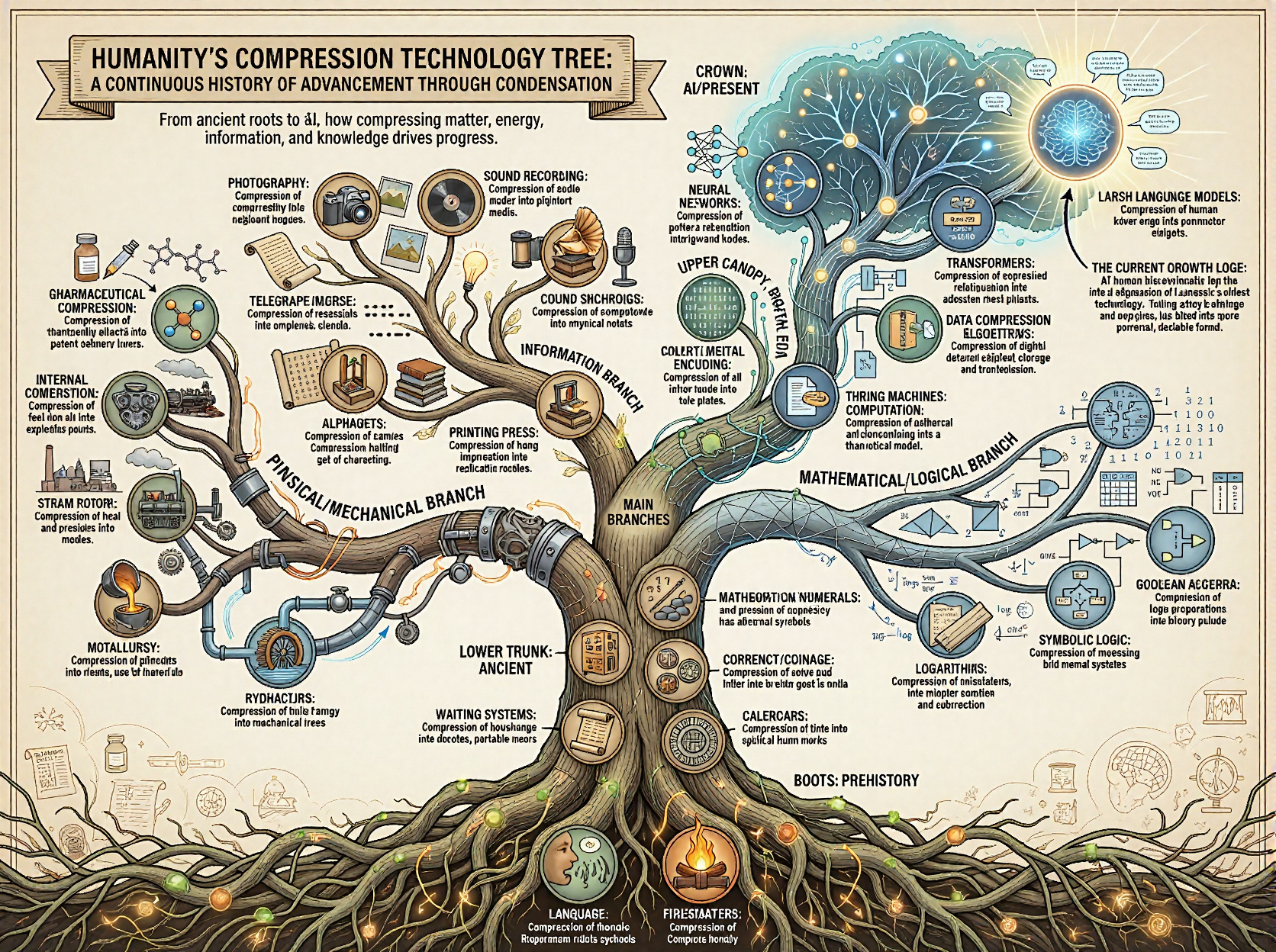
The Compression Engine: From Fire to AI, One Ancient Technology
Most programmers would agree that AI coding assistants and agents are remarkable tools. I count myself among them. After years of writing code the traditional way—searching documentation, Stack Overflow diving, trial and error—I now work alongside something that feels genuinely different. Not just faster. Different.
It seems inevitable that software development would be the first industry transformed this dramatically. The creators have built something like unto themselves: an analytical engine that reasons about the very medium it was constructed from. Code writing code. Patterns recognizing patterns. There's a poetic recursion to it.
But I've come to believe that what we're witnessing isn't as unprecedented as it first appears. AI represents the latest breakthrough in something humans have been doing since we first walked upright: compression.
What Do I Mean by Compression?
When I say compression, I don't just mean making files smaller. I mean the fundamental human act of taking something complex, unwieldy, or diffuse and condensing it into something more potent, portable, and useful.
Think about it. A word is compressed experience. The word "danger" contains within it every close call, every predator encounter, every cliff edge that our ancestors survived and needed to warn others about. One syllable. Infinitely reusable. Instantly transmittable.
Writing compressed speech into marks that could outlive the speaker. Mathematics compressed quantity and relationship into symbols you could manipulate without counting actual objects. Currency compressed the messy complexity of barter—how many chickens for a cow? what if I don't need chickens?—into standardized tokens that represented value itself.
This isn't metaphor. This is mechanism.
The Physical Branch
Compression isn't just an information technology. Some of humanity's most transformative discoveries came from compressing physical matter and energy.
Metallurgy compresses heat and chemical transformation into a repeatable process that turns soft earth into hard tools. The arch compresses gravitational force into a shape that creates strength from what would otherwise cause collapse. Hydraulics, understood intuitively by ancient engineers and formalized by Pascal, compresses liquid to transmit force across distance and multiply human strength.
The internal combustion engine compresses fuel and air into a chamber, then releases that compression as controlled explosion—thousands of times per minute, propelling tons of metal down highways at speeds our ancestors would have considered supernatural.
Even the pills in your medicine cabinet represent compression technology. Pharmaceutical tablets compress precise doses of active compounds into stable, portable form with engineered release mechanisms. The chemistry is complex. The delivery is simple. That's compression working.
The Information Branch
Parallel to physical compression, humans developed increasingly powerful ways to compress information itself.
The alphabet was a compression breakthrough that doesn't get enough credit. Earlier writing systems required thousands of symbols—one for each word or concept. Alphabets compressed language into a few dozen phonetic units that could be recombined infinitely. Literacy became achievable for ordinary people, not just specialized scribes.
The printing press compressed the act of copying. What once required months of careful hand-transcription became mechanical reproduction. Knowledge could spread at unprecedented speed, and the cost of books fell by orders of magnitude.
The telegraph compressed language into electrical impulses that traveled at nearly the speed of light. Morse code was itself a compression algorithm—common letters got short codes, rare letters got long ones. Information theory before information theory had a name.
Photography compressed visual reality into chemical reaction. Sound recording compressed acoustic vibration into physical grooves, then magnetic patterns, then digital samples. Each step: take something rich and complex, find its essential structure, encode that structure in a more portable form.
The Digital Synthesis
Digital binary represents a kind of universal compression substrate. By reducing all information to sequences of ones and zeros, we created a medium that could encode anything: text, images, sound, video, instructions, relationships, transactions.
The elegance is almost unsettling. Two states. On and off. Yes and no. From this minimal foundation, we built everything from spreadsheets to streaming video to the device you're reading this on.
Data compression algorithms pushed further, finding redundancy and pattern in digital information to squeeze it smaller still. When you stream a movie, you're watching the result of decades of research into how much information you can throw away before humans notice the loss. The answer: most of it.
Computation itself is compression. A Turing machine compresses the concept of "any possible calculation" into a simple theoretical device with a tape and a read-write head. That compression proof showed us that general-purpose computers were possible—that we didn't need a different machine for every different task.
The AI Branch
Which brings us to now.
Neural networks compress pattern recognition into mathematics. A network trained to recognize faces has somehow encoded, in millions of numerical weights, the statistical essence of what makes a face a face. It doesn't store faces. It stores something more compressed: the pattern beneath faces.
Deep learning stacked these compressions. Early layers compress raw pixels into edges. Middle layers compress edges into shapes. Later layers compress shapes into concepts. The hierarchy mirrors how our own visual cortex processes information, suggesting that this compression architecture isn't arbitrary—it's something close to necessary.
Transformers and attention mechanisms found ways to compress sequential relationships—how words relate to other words across long stretches of text, how context shapes meaning. The breakthrough was technical, but its effect was to enable compression at a new scale.
And large language models? These compress something almost too large to name. Billions of pages of human writing. Centuries of accumulated knowledge, argument, story, instruction, conversation. Compressed into parameter weights that, against all reasonable expectation, can be queried and recombined to produce coherent, useful, sometimes genuinely insightful responses.
When a developer asks an AI assistant to help debug a function, they're querying compressed programming knowledge—millions of code examples, documentation pages, forum discussions, all somehow encoded in a form that can engage with their specific problem. It's not retrieval. It's not search. It's something more like reconstruction from compressed representation.
What It Feels Like to Work This Way
Working alongside AI as a software developer turns out to be an interesting optimization problem: utilizing these tools as much as possible without sacrificing quality.
AI is remarkably good at certain things. Boilerplate code. Standard patterns. Explaining unfamiliar libraries. Suggesting approaches that might not have been considered. Catching obvious errors. Generating tests.
It's less reliable at other things. Novel architecture decisions. Understanding the full context of a large codebase. Knowing which tradeoffs matter for a specific project with specific constraints. Recognizing when a "correct" solution is wrong for reasons that live outside the code itself.
Working well with AI means developing intuition for where the compression holds and where it breaks down. The model has compressed a lot of programming knowledge, but compression is lossy. Edge cases get smoothed out. Rare patterns get underweighted. Context that existed in the training data doesn't always survive into the weights.
The skill becomes knowing when to trust and when to verify. Treating the AI as a brilliant colleague who might be confidently wrong. This isn't a criticism—it's just the nature of compression. You can't encode everything. Understanding what got left out is part of the craft.
The Trunk of the Tree
Here's what strikes me most: AI isn't a discontinuity. It isn't some unprecedented rupture in human history. It's the latest branch on a very old tree.
Humans have been compressing things since before we were fully human. We compressed experience into language. We compressed language into writing. We compressed matter into tools, energy into engines, value into currency, knowledge into books and then into bits.
Every major compression breakthrough followed a similar pattern. Someone figured out how to take something large and encode it smaller while preserving—or even enhancing—its useful properties. And every time this happened, humanity's capabilities expanded dramatically. Not because we became smarter, but because we could do more with less. Store more knowledge in smaller spaces. Transmit more meaning with fewer symbols. Generate more power from less fuel.
AI continues this pattern. We've figured out how to compress human reasoning patterns, knowledge structures, and linguistic capabilities into mathematical models that can be queried and recombined. The compression is imperfect—all compression is imperfect—but it's potent enough to feel transformative.
Looking Up the Trunk
What comes next on this tree? Nobody knows.
But the pattern will likely continue. Somewhere, someone is working on the next compression breakthrough—some way to encode something we currently consider uncompressible into a more potent form. Maybe it's reasoning itself. Maybe it's scientific intuition. Maybe it's something we don't have a name for yet.
The analytical engine has surpassed its predecessors by leaps and bounds. And it's still, at root, the same technology humans have always used: taking the complex and making it compact, taking the diffuse and making it dense, compressing the world into forms we can carry forward.
We're good at this. We've always been good at this. And we're getting better.
Ready to implement ML in your business?
Contact our team for personalized guidance and implementation support.
Get Started Today